Whenever somebody has to talk about who they are, they mostly refer to their credentials. A Bachelor’s Degree in Commerce, A Masters in Economics. That’s perfect.
I am currently enrolled at the University of Life, navigating my way through the module on “Finding yourself” with a mid-term paper on “What is my purpose?” due next term, whenever that will be.
There are only a handful of things I know for certain. I know that I am in love with a soulful gal that buys into my crazy ideas and ways. I know that I like to eat. And I know that I was born to write.
I invite you to see the world through my eyes as I speak my truth in different forms. Be they scripts, short stories or articles, you can rest assured that each and every word is true to the letter.
Is anything really ever black or white, good or bad, right or wrong? Or do we all live in the grey: a space where there’s good in bad, bad in good and neither bad nor good. It’s all relative anyway, right?
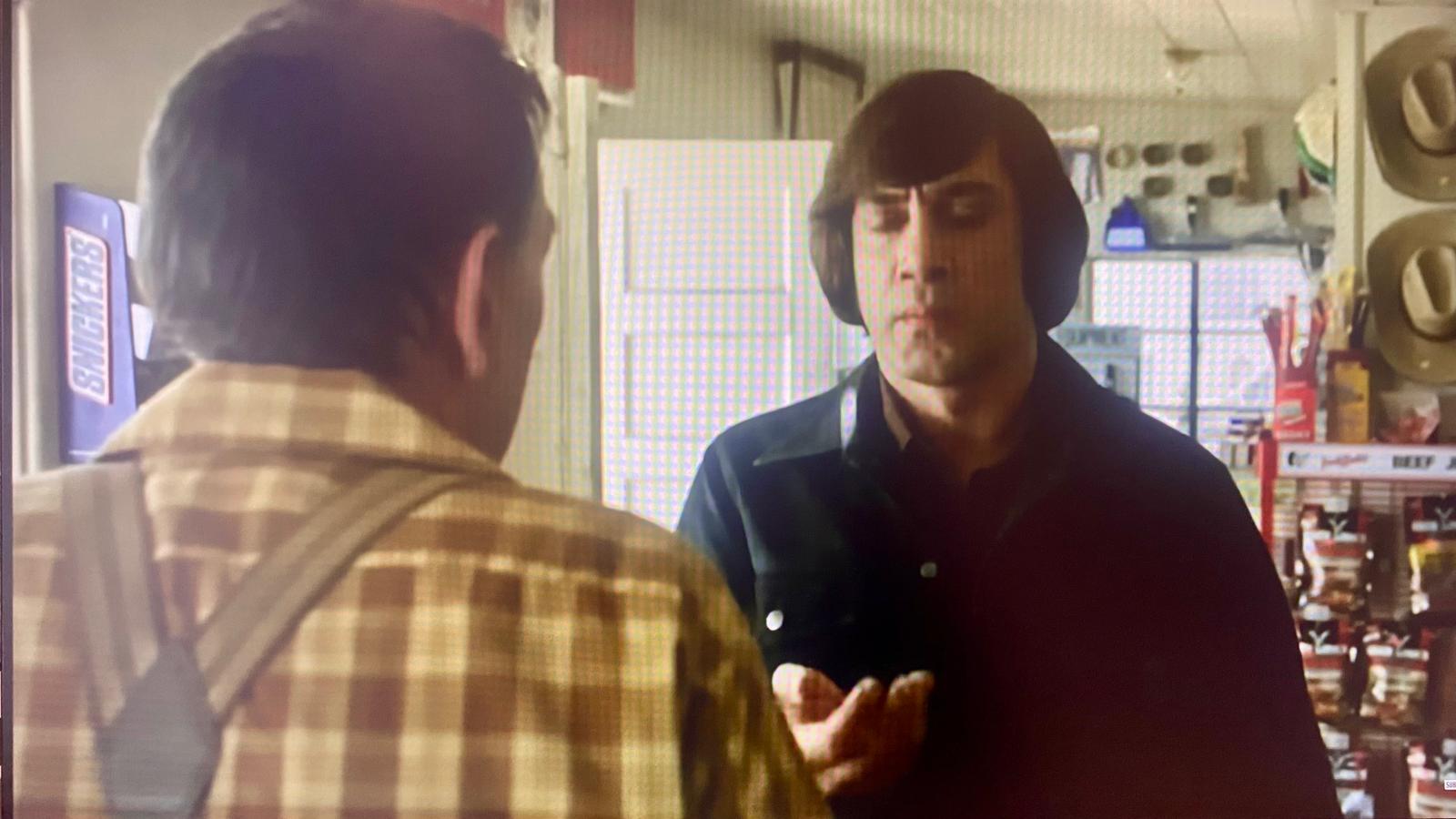
For our second showing at film club, we made a drastic shift from Bela Tarr’s thought-provoking Werckmeister Harmonies to the Coen Brothers’ cinematic adaptation of Cormac McCarthy’s novel No Country for Old Men, starring Javier Bardem playing a ruthless cold-blooded assassin, pre-Thanos Josh Brolin taking on the role of an “oafish” welder and peak Tommy Lee Jones reprising the role of a jaded Sheriff.
The Good, the Bad and the Ambiguous
Javier Bardem is a killer. There’s no question about it. He goes about his job with a calculated coldness. At the same time, he has many admirable qualities. He’s a man of principle. He offers victims the chance to live with a coin toss. If the victim wins the coin toss, he keeps his word and they live. And if they lose the coin toss, he also keeps his word and they don’t live. He’s also highly meticulous, detail-oriented and precise. Granted he shouldn’t be killing anyone in the first place, but as far as his work goes, you could say he’s actually pretty good at it.
Josh Brolin shouldn’t be involved in any way. But after he stumbles upon a car packed with cash and coke, he’s as good as dead. Without trying to oversimplify things, Josh Brolin is the “good guy” in the film. Meaning he’s the one being hunted and has no intention of killing or hurting anybody. But unlike the killer, Josh Brolin’s character has no principles. He’s married, but still eyeballs other women. He’s also sloppy, leaving a trail wherever he goes and can oftentimes be frustrating to watch because of this sloppiness. A “good” guy that’s not very admirable.
And then you’ve got Tommy Lee Jones playing the jaded, soon-to-be-retired Sheriff. As far as Sheriff’s go… he just gives up. He almost can’t be bothered to try and catch the killer. And he admits as much in the final scene, where he talks about a dream in which he meets the killer and resigns to the fact that he simply can’t keep up with him, captured perfectly in this monologue:
It was like we was both back in older times. And I was a-horseback, going through the mountains of a night. Going through this pass in the mountains. It was cold, and there was snow on the ground. And he rode past me and kept on going, never said nothing going by, just rode on past. He had his blanket wrapped around him and his head down. When he rode past, I seen he was carrying fire in a horn, the way people used to do, and I… I could see the horn from the light inside of it, ’bout the color of the moon. And, in the dream, I knew that he was going on ahead. He was fixin’ to make a fire somewhere out there in all that dark and cold. And I knew that whenever I got there, he’d be there. And then I woke up.
A bad guy with principles. A good guy without principles. And a Sheriff who’s just given up. If this isn’t moral ambiguity, I don’t know what is.
Is intent the line between good and evil?
In the great ancient Indian Epic, the Mahabharata, there are two key figures; Krishna fighting for “good” and Shakuni fighting for “evil.” On the surface, their MO’s are pretty identical. Both use psychological warfare to gain advantage. Both play a zero-sum game and both use deception to further their side’s cause.
In fact, when it comes to it, Krishna is the very personification of moral ambiguity, breaking all the conventional rules of warfare, instructing Arjuna to strike down an unarmed Karna, deliberately manipulating a lie to defeat Drona and even using a human shield against Bhisma. Yet, he has been deified across several prominent cultures, raised to the level of a God, his name chanted the world over.
So what’s the difference between Krishna and Shakuni?
Whereas Shakuni was Machiavellian in pursuit of a petty vengeance against the Pandavas, Krishna used these methods to serve a higher Cosmic order, with no individual accolade or reward presented to him for his efforts.
This begs the question: does the end justify the means? Was Krishna right to break the rules? What about our killer in No Country for Old Men? Principled as he was, what motif was he serving other than his own Ego? And even if it was some Greater Good, is his killing in any way justified?
There is another Hindu principle: Dharma, doing one’s duty without attachment to the outcome. If the killer viewed it as his duty to kill as part of his job, does this justify the deaths of the ones who stood in his way?
Life is complicated
As a society, we’ve gotten into the habit of putting things into the “good” vs “bad” box, without considering the grey areas. Take the scene from The Morning Show on Apple TV, where a man has been incriminated for sexual misconduct and a group of female employees, none of whom were his victims, are passionately calling for his “balls to be chopped off.” That’s when one of the main characters, Mia, steps in and says:
First of all, how old are you? 24? Actually why don’t you try giving it 20 years (to see if you still want them to cut his balls off) and with all due respect, you’ve been at your job 18 months, what the fuck do you know about this show, what it’s been, what I’ve seen, what I’ve gone through since I’ve been on this show […] it’s not as black and white as you are stating it. This shit is complicated. People are complicated. Mitch (the one incriminated played brilliantly by Steve Carrell) was complicated. And he was a part of this show. And I care deeply for this show.
It brings to mind another scene from Do the Right Thing, which we saw during film club, which you can read more about here. In short, Sal has a pizzeria that becomes the centre of controversy after he refuses to have any famous black people on the restaurant’s “wall of fame” not out of spite, but simply out of choice. Sal doesn’t see black and white. He sees customers. Yet he’s wrongfully incriminated by a society hellbent on creating division and chaos, when all people should really be doing is enjoying the fucking pizza.
As for No Country for Old Men, I’ll leave it to you to decide what was right and wrong, who was good and bad. But if you’re able to stay in the grey, you’d have reached equanimity before GTA VI (can we still use that reference?).



Leave a Reply